
 111
111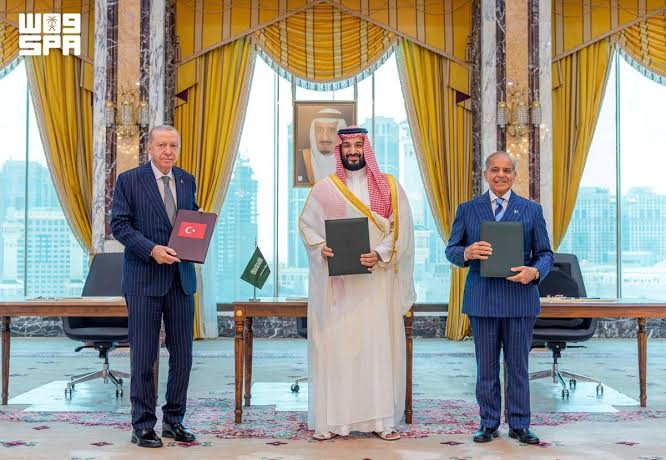 2
2 3
3 Saudi Arabia, Turkey, and Pakistan have officially signed the Mecca Joint Defence Agreement, establishing a strategic mutual defense pact designed to enhance collective security and deterrence across the broader Middle East and South Asia regions. The landmark pact was signed at Al Safa Palace in Mecca by Saudi Crown Prince Mohammed bin Salman, Turkish President Recep Tayyip Erdogan, and Pakistani Prime Minister Shehbaz Sharif during a high-level tripartite summit convened to address escalating regional instability. Under the core clause of the agreement, an armed attack against any one of the three member nations will be formally treated as an attack against all three, establishing a unified defense posture aimed at safeguarding national sovereignty and key economic assets. Saudi official representatives emphasized that the treaty is not intended to function as an aggressive military bloc or sectarian alliance, nor is it directed against any specific nation, but rather serves as a stabilizing framework for shared defense cooperation. Turkish officials clarified that the mutual defense arrangement fully aligns with Ankara’s existing commitments as a NATO member, providing an additional mechanism to support regional diplomatic and security equilibrium. For Pakistan, the agreement cements deep-standing strategic ties with Riyadh and Ankara, opening up structured avenues for defense technology transfer, joint military training exercises, and intelligence sharing. The tripartite declaration outlines plans to establish operational committees tasked with coordinating maritime security, counter-terrorism initiatives, and air defense monitoring across overlapping domains. Regional political analysts note that the creation of this alliance reflects shifting geopolitical dynamics in the Gulf, as major regional powers seek broader multipolar security partnerships amid persistent global uncertainties. The summit also touched upon expanding trilateral economic trade, energy infrastructure investments, and technology transfers to complement the overarching security pact. The agreement comes at a critical juncture when vital commercial trade corridors across the Arabian Sea and adjacent waterways require heightened defense readiness. Joint military delegations from the three countries are scheduled to convene in Riyadh in the coming weeks to draft implementation protocols and operational guidelines for the newly formed alliance. Defense ministers from all three states hailed the accord as a historic milestone in Islamic solidarity and regional peace, reinforcing long-term defense self-reliance. Overall, the Mecca Joint Defence Agreement marks a pivotal transformation in Gulf security architecture, signaling a coordinated effort among key regional powers to maintain stability, protect critical infrastructure, and prevent future security crises across the Gulf and beyond.